
Pilot Launch | Making Risk Visible: How Satellite Data and AI Could Unlock Flood Insurance for Mexico’s Small Businesses
Written by Maria Gomez, Climate Venture Lab Lead at Prosper Global Ventures, and Alexa Lopez, Floodbase
In Brief
Prosper Global Ventures launched a pilot with Floodbase as part of a new cohort of pilots focused on climate resilience tools for small and medium-sized businesses.
Flooding is the most common and costly disaster in Mexico, yet small businesses are almost entirely unprotected: only 2-5% of micro and small enterprises carry any insurance, and flood risk is invisible to most owners until it’s too late.
Through this pilot, Floodbase is deploying a platform that delivers real-time flood alerts, localized flood history, and a menu of parametric insurance options, making risk visible and actionable for SMEs for the first time.
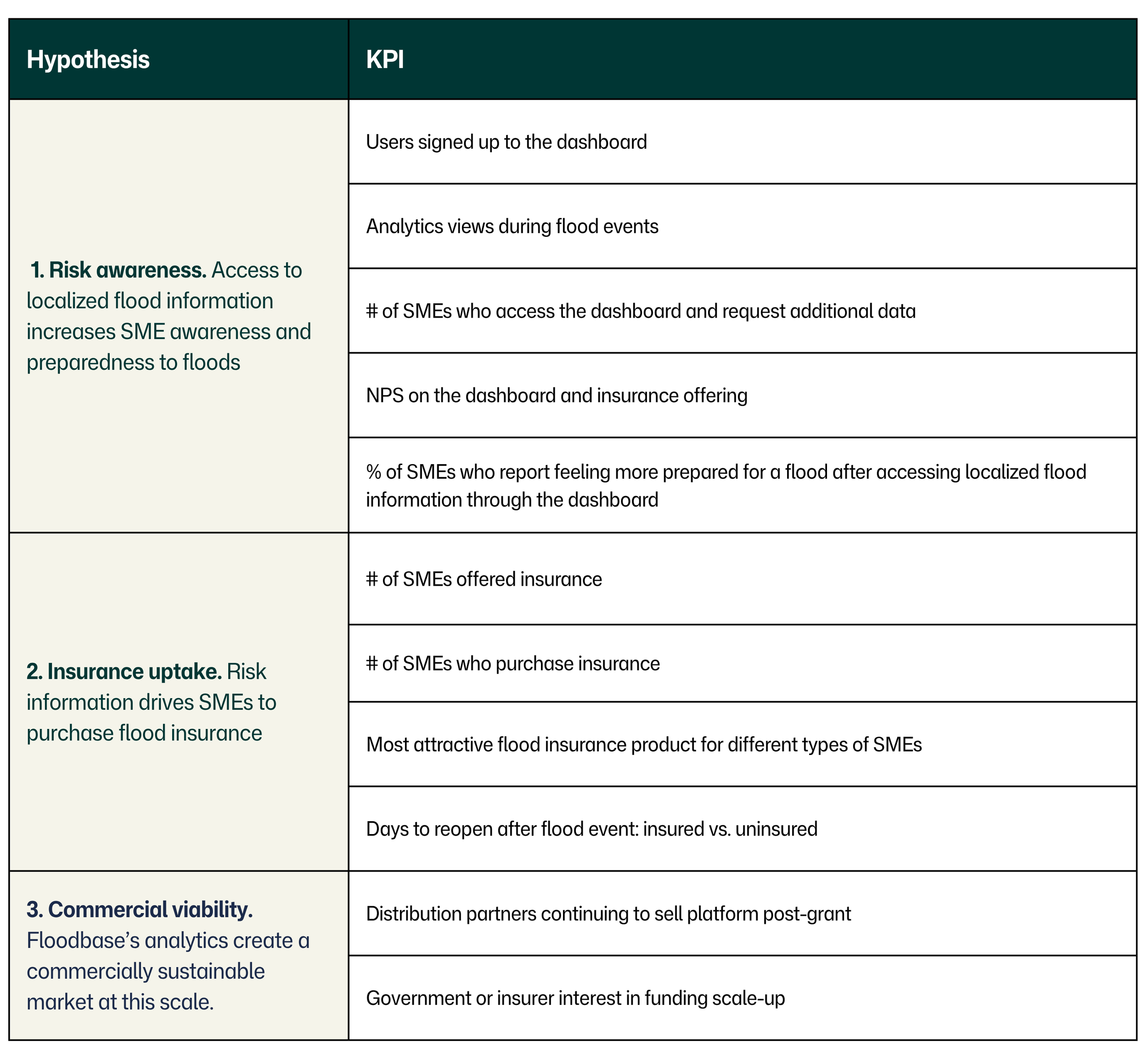
We are testing two core hypotheses: first, that access to personalized flood risk information increases awareness and preparedness among small business owners; and second, that this awareness translates into insurance uptake, and ultimately, faster recovery when floods hit. If both prove true, we aim to generate the evidence needed to convince insurers and the Mexican government to step in and serve this market at scale.
Prosper Global Ventures has launched a pilot with Floodbase, a climate technology company that uses satellite imagery and AI to deliver real-time flood intelligence and parametric insurance. Together, we are testing whether giving small and medium-sized businesses (SMEs) in Mexico access to flood risk data and, a straightforward way to buy insurance, could meaningfully change how they prepare for and recover from climate shocks.
SMEs are the backbone of economies across the Global South, and they face acute exposure to climate shocks with few tools to manage it. This pilot is part of a new cohort we’re launching focused on urban climate resilience: how do we help small businesses build the financial and informational infrastructure to withstand climate events?
The Problem
Small businesses in Mexico are flying blind to flood risk
Small and medium-sized businesses are the backbone of Mexico’s economy, accounting for 99% of all companies and generating over 70% of formal employment. Yet, they are vulnerable to climate shocks and have few tools to manage that risk.
Flooding is the most common and costly climate disaster in Mexico, causing over $400 million in damage annually. For small businesses, a single flood event can be existential. It often means inventory destroyed, operations shut down for days or weeks, and customers lost with no financial cushion or proper risk mitigation tools. In Tabasco for example, in 2020 10-15% of small businesses were directly affected by floods and lost over 130 million pesos in lost sales from flooding related business closures.
Why are SMEs so exposed? The problem has two reinforcing layers. The first is awareness: according to Mexico’s insurance industry association, only 2% of microenterprises, 5% of small businesses, and 30% of medium-sized businesses in the country carry any insurance. Flood risk is invisible to most business owners and abstract until they experience it themselves. The second layer is access: even for businesses that do want to act, the market isn’t designed for them. Floods are notoriously difficult to price at the neighborhood level, and the overhead of traditional insurance, including loss assessors, lengthy underwriting, manual claims, makes it economically unviable for insurers to serve small businesses at scale.
The result is a cycle that feeds itself: small businesses don’t think about flood risk, so they don’t seek insurance; insurers don’t see demand, so they don’t build products for SMEs. Floodbase’s approach is designed to break that cycle by first making risk visible and then making it easy to act on. That sequencing is what this pilot sets out to test.
The Pilot
Prosper Global Ventures is partnering with Floodbase to test whether satellite- and AI-powered flood intelligence can unlock both risk awareness and insurance uptake among Mexican SMEs — for the first time.
About Floodbase
Floodbase has spent a decade building what is now the world's leading platform for flood monitoring and parametric insurance, combining satellite imagery, hydrological models, and machine learning to produce real-time and historical flood maps at global scale. Their technology is used by 32 governments and leading insurers and has been applied in flood resilience programs across the US, Europe, Latin America, and Asia.
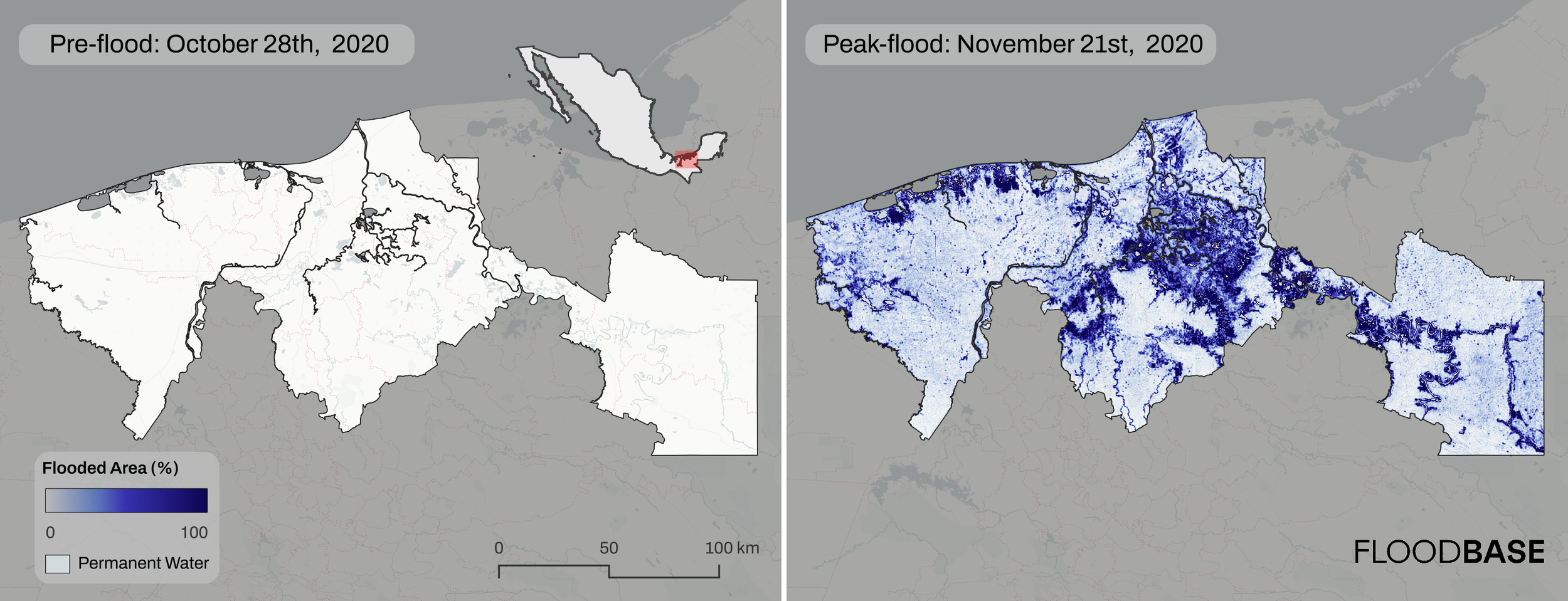
Floodbase flood monitoring in Tabasco, Mexico
Until now, Floodbase's work has primarily served large institutional clients: governments, major insurers, and large commercial enterprises. This pilot marks a deliberate step in a new direction, bringing that same world-class flood intelligence directly to small business owners who have never had access to it before and pairing it with insurance products designed specifically for their needs and budget.
“Small businesses are on the front lines of climate risk, yet they’ve often been shut out of the tools and financial products that could protect them. This pilot is designed to close that gap. We’re bringing the flood intelligence we’ve built for governments and major insurers directly to small business owners and pairing it with insurance that actually fits their reality.” - Bessie Schwarz, Co-Founder & CEO, Floodbase
What we're testing
For this pilot, Floodbase has designed a platform with three interconnected features:
Real-time flood alerts. Business owners can sign up to monitor their area and receive alerts as flood events develop, giving them timely information to protect their assets and operations when it matters most.
Localized flood history and risk exposure. The platform shows each business their specific location's flood history, including past events, their frequency and severity, in a form that makes risk legible and personal. Rather than abstract statistics, a business owner sees their own data: has this happened here before, and how bad was it?
A menu of insurance options. From within the same platform, business owners can select parametric insurance coverage tailored to their situation; choosing their coverage limit, premium, and payout frequency based on their specific risk profile. Payouts are triggered automatically when a qualifying flood is detected by satellite, with no loss adjuster required.
This last piece is made possible through Floodbase's partnerships with Raincoat, a parametric insurance platform with established customers in Mexico, and Liberty Mutual, Floodbase's carrier partner in the country. Together, the three organizations are building both sides of what has been missing: a risk awareness platform that makes floods visible, and a distribution channel that makes insurance accessible, in a single, seamless experience.
Parametric flood insurance for SMEs does not exist in Mexico today. The innovation we're testing is not just technical, it's testing whether making risk visible and actionable, in the right form and at the right price point, is enough to move small business owners from unawareness to protection.
Learning Agenda and Key Hypotheses
The pilot was launched in January 2026 and runs through June 2026 throughout Mexico. We are testing three core hypotheses:
Why This Pilot Matters
The financial protection gap for small businesses in climate-vulnerable markets is one of the most stubborn problems in climate resilience finance. Not because the technology doesn’t exist, but because no one has yet built the distribution model to connect it to the businesses that need it the most.
If we can show that SMEs will engage with flood risk data, that they will buy insurance when its accessible and priced right, and that parametric products reduce recovery time, we create a compelling case for Mexico’s government and private insurers to step in at scale. The same market failure exists across Latin America and Sub-Saharan Africa, hundreds of millions of small businesses operating with almost no financial protection against climate risk.
Providing the model works is the first step to changing that.