
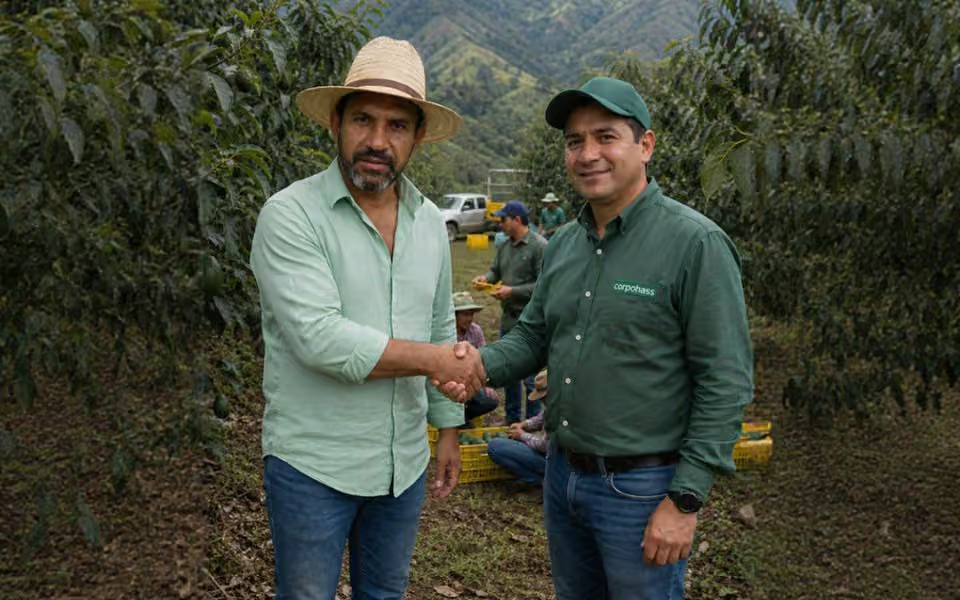
In Antioquia, climate variability puts up to 60% of the annual coffee harvest at risk, making timely, farm-level guidance critical for farmers.
This post will be followed by other posts highlighting key insights after the pilot is completed. Written by Maria Gomez, Climate Venture Lab Lead at Mercy Corps Ventures and Luis Miguel Gonzalez, CEO Harvis
In Brief
Climate variability puts up to 60% of Antioquia’s annual coffee harvest at risk. The support system is insufficient; extension workers reach fewer than half of farmers, and existing forecasting tools are too broad and too slow to be useful at the farm level.
Harvis is a WhatsApp-based AI agronomist that Colombian agritech company Tecde has been developing for the past few years. Farmers already use it for daily crop advice and agronomic questions. It is free for farmers cooperatives and buyers fund access.
This pilot adds hyper-local agroclimatic alerts that combine data from Cenicafe, IDEAM, and global weather APIs, translated by AI into farm-specific recommendations delivered via WhatsApp through one anchor partner, Cocafisa.
We want to test if farmers act on those alerts, whether that shifts them from reactive to preventive decision-making, and whether those changes show up in coffee quality and yields.
Growing up close to a coffee farm in Colombia, I learned that farmers worry about everything. My dad would come home complaining about rust wiping out our neighbor’s crop, or prices dropping while input costs stayed the same, or the peso strengthening just enough to eat into what looked like a good harvest. Coffee farming is hard. Prices are set in dollars by forces completely outside a farmer’s control, markets shift, and pests evolve.
And then there is the weather. If you grew up in Colombia, you know that checking a weather app and planning your day around it is pointless. You look out the window and prepare for everything. Rain, sun, clouds, crazy fog, and chilly nights. The weather in the Andes has always been local and unpredictable. But the patterns farmers learned over the years, when the rains come, when they stop, what a normal dry spell would look like, are becoming less reliable. Too much rain at the wrong time ruins the drying process. Too little rain during flowering reduces grain weight and cuts yields. In Antioquia, one of the main coffee growing areas in the country, up to 60% of the annual coffee harvest is at risk each season from climate variability alone.
Farmers have always faced uncertainty. What is changing is how much of it there is, and how little support they have to navigate it.
That is the challenge Prosper Global Ventures is partnering with Harvis to tackle. We are launching a seven-month pilot to test how farmers engage and act based on hyper-local weather alerts and personalized recommendations provided by Harvis, a WhatsApp-based AI agronomist.
The Problem
Colombia’s national weather agency, IDEAM, produces climate forecasts. Cenicafé, the country’s world-class coffee research institute, publishes monthly agroclimatic bulletins. The science and the information exist. The problem is that neither tool reaches a farmer in a way they can act on. IDEAM’s forecasts are broad and low-resolution, poorly calibrated to the mountain microclimates where Colombian coffee grows. Cenicafe’s bulletin is 40 pages of technical analysis. By the time a farmer encounters it, if they do, it has already aged.
The extension system has the same problem at the human level. Each extension officer is responsible for over 500 farmers, resulting in forty percent of farmers receiving no advisory support at all. When a climate event arrives, most farmers face it without advice.
The result is reactive farming. Fertilizer applications get washed out by rains that could have been anticipated. Drying mistakes leads to fermentation losses. Harvests misaligned with ripening windows. Income that should have been protected is lost.
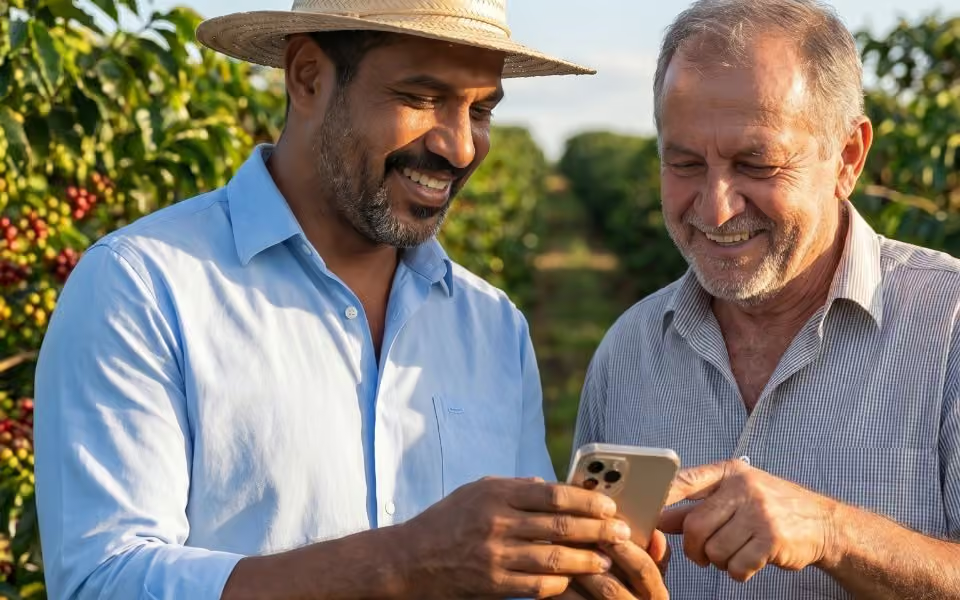
Through Harvis, farmers receive hyper-local agroclimatic alerts and personalized recommendations via WhatsApp, combining weather data with AI to support decisions at the farm level.
The Pilot
Harvis is a WhatsApp-based AI agronomist that farmers use for crop advice, cost estimates, and agronomic questions. It has grown largely through farmer-to-farmer sharing, with a 38% average monthly user growth rate.
This pilot tests hyper-local agroclimatic alerts built specifically for coffee farmers in Antioquia. To generate them, Harvis combines Cenicafe’s monthly agroclimatic research, IDEAM national forecasts, and real-time global meteorological data, then uses AI and each farm’s geolocation to translate all of that into short, farm-specific alerts delivered via WhatsApp. Not a 40-page bulletin. A message that tells a farmer in Salgar what the weather is coming in the next three days and what to do about it.
The pilot runs through one anchor partner: the Cooperativa de Caficultores de Salgar (Cocafisa), a cooperative with 3,000 farmer members in Salgar. Cocafisa's version of Harvis will combine the weather alerts with services specific to their farmer relationships, from tracking payments to monitoring coffee quality. The goal is to test not just whether the alerts work, but whether embedding them inside a trusted buyer relationship increases the chance that farmers act on them.
Tecde has also built in engagement mechanisms to sustain participation over time. Harvis tracks how farmers interact with alerts and recommendations, ranks participation, and in some cases enables partners to offer rewards, like discounts on agricultural inputs, to the most active users. Farmers access the platform for free. Partners fund access through a license fee, aligned by their interest in supply quality and continuity.
“I started at 13. My dad gave me a plot, and I saw it as a business from day one. Today, I roast my own coffee, I have my own brand, and I’ve helped several neighbors launch theirs too. Harvis helps me turn that passion into a real business. I learn something new every time I ask it a question. Imagine how far someone can go when they fall in love with coffee that young and have the technology on their side.” Alejandro, coffee grower
What we want to learn
“I found it [Harvis] on Facebook by accident. I tried it for a cilantro crop and haven’t put it down since. It estimates my costs, gives me technical recommendations, and I have it on WhatsApp, which is how I operate. A technician visit costs 200,000 pesos. Harvis is free. Last year the rains wiped out my cilantro. I lost 4 million pesos. I wish I had Harvis then. Would I recommend it? 10/10. It helps you have a better quality of life.” Samuel, Union Leader
We structured the pilot around three core questions, rooted around how to make AI-powered hyper-local agroclimatic alerts an impactful and effective solution.
The first is behavior change. Do farmers who receive localized agroclimatic alerts shift from reactive to preventive decision-making? We are targeting more than 60% active adoption, and we want to see at least 500 farmers document a change in practice, such as adjusting drying times, rescheduling fertilizer applications modifying harvest windows, based on a Harvis alert.
The second is the impact on quality. Coffee quality is measurable. The Cooperativa de Caficultores de Salgar (Cocafisa) will track the dry-yield factor of coffee delivered by Harvis uses versus a non-user comparison group at collection points. We are targeting a 7% improvement in dry-yield factor for active users, and we expect to see a measurable reduction in fertilizer applications washed out by predicted rainfall.
The third is commercial sustainability. The pilot will only have demonstrated its full value if the evidence it generates convinces at least one cooperative or buyer to commit to a post-pilot commercial agreement. That is the signal that the model works beyond the grant period.
Learning Agenda
Why we backed this pilot
Last year, we launched a call for proposals focused on climate resilience in Colombia. We received 116 applications, of which 47% were focused on adaptive agriculture and food systems. We looked for solutions that were technically credible and innovative, built by a team that understands the context, and designed to sustain itself without a permanent subsidy.
Harvis cleared all three bars. Harvis meets farmers where they already are. The B2B model means cooperatives and buyers fund access, not ongoing grants. And Luis and his team have deep roots in Colombian rural communities, which matters when you are asking farmers to trust a new tool with decisions that affect their livelihoods.
Before the pilot launched, we spent time with the Harvis team mapping exactly what we want to learn and agreeing on metrics that will let us honestly stress-test each hypothesis. We will share the results and lessons learned when the pilot closes in December.
Harvis brings together farmer engagement, climate alerts, and field records in one platform, supporting the delivery of more localized agricultural guidance.
The bigger picture
Over 40,000 families in Southwestern Antioquia depend on coffee income. In municipalities like Salgar, 90% of the rural population relies on it. If Harvis works at the scale we are testing, the path to reaching all of them is a matter of distribution and partnership, not a fundamental rebuild of the technology.
Beyond Antioquia, the implications are significant. Colombia has more than 500,000 coffee farming families. Similar dynamics play out in smallholder agriculture across Latin America, where the gap between world-class agronomic science and on-farm decision making is wide; extension systems are stretched thin, and climate variability is accelerating.
The pilot runs from May through December 2026. We will share what we learn.
For more on Prosper Global Ventures’ AI for Climate Resilience Work, visit our Climate Venture Lab.